How to Play
The goal of Frequency is to fill in each empty grid with numbers that satisfy the following conditions:
Use the numbers 1 through n for any n x n grid.
Example: A 4×4 grid can be filled in using 1, 2, 3,
and 4.
Satisfy the sum of each row and column, located in cubbies outside the grid on the right and bottom, respectively.
Example: A 4×4 grid with a sum of 8 could be
filled in using 1124, 1133, 1223, or 2222.
Satisfy the frequency of each row and column, located outside the grid on the left and top, respectively. The frequency represents the maximum number of times any one digit can occur in that row or column. Possible frequencies include:
1 - Every number occurs exactly once.
4×4 Example: 1234 only
2 - One number occurs exactly twice, and the
other numbers occur once or not at all.
4×4 Examples: 1124, 2334
2² - Two numbers each occur exactly twice,
and the other numbers occur once or not at
all.
4×4 Examples: 2233, 1124
6×6 Examples: 114456, 223346
2³ - Three numbers each occur exactly twice,
and the other numbers occur once or not at
all.
6×6 Examples: 112255, 224466
3 - One number occurs exactly three times,
and the other numbers occur twice, once,
or not at all.
5×5 Examples: 55533, 55541
6×6 Examples: 555123, 444662
3² - Two numbers occur exactly three times,
and the other numbers occur twice, once,
or not at all.
6×6 Examples: 222555, 111222
4 -One number occurs exactly four times, and…
4×4 Examples: 3333, 4444
6×6 Examples: 111155, 222236
5 - One number occurs exactly five times, and…
5×5 Examples: 33333, 55555
6×6 Examples: 222223, 666665
6 - One number occurs exactly six times, and…
6×6 Examples: 111111, 555555
Follow this sample logic for the 4×4 grid shown below:
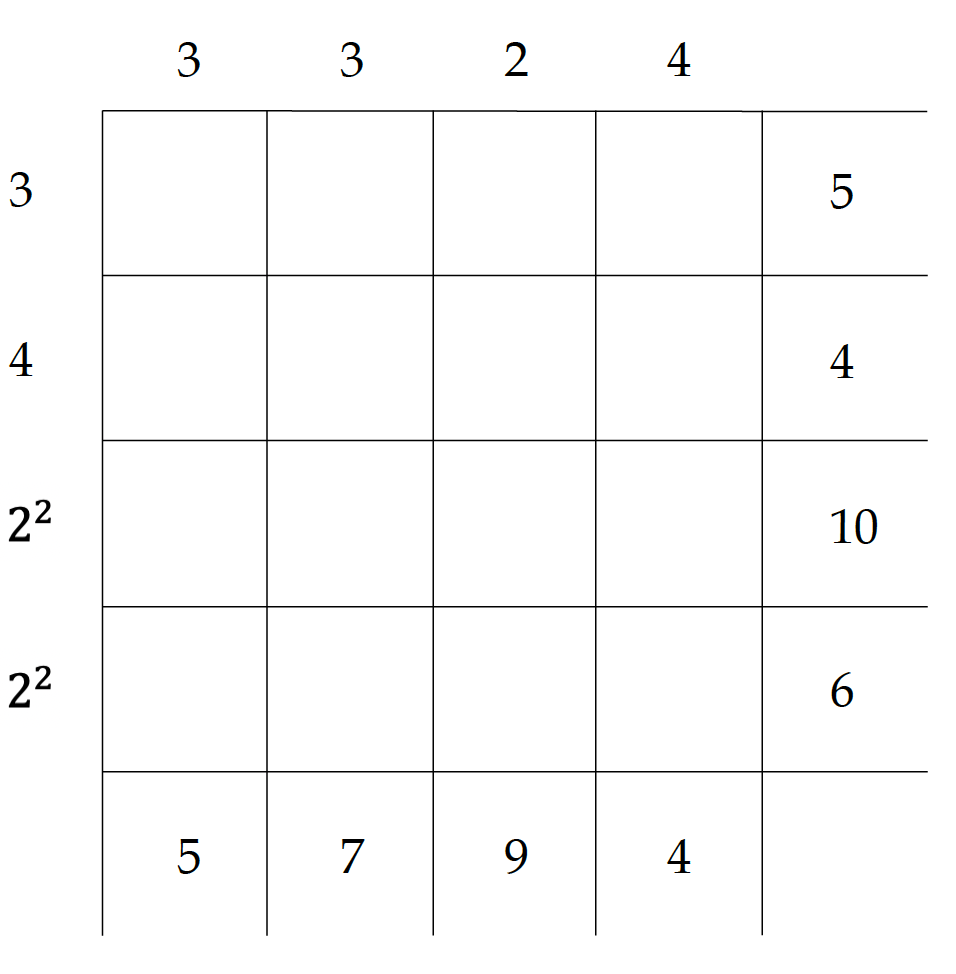
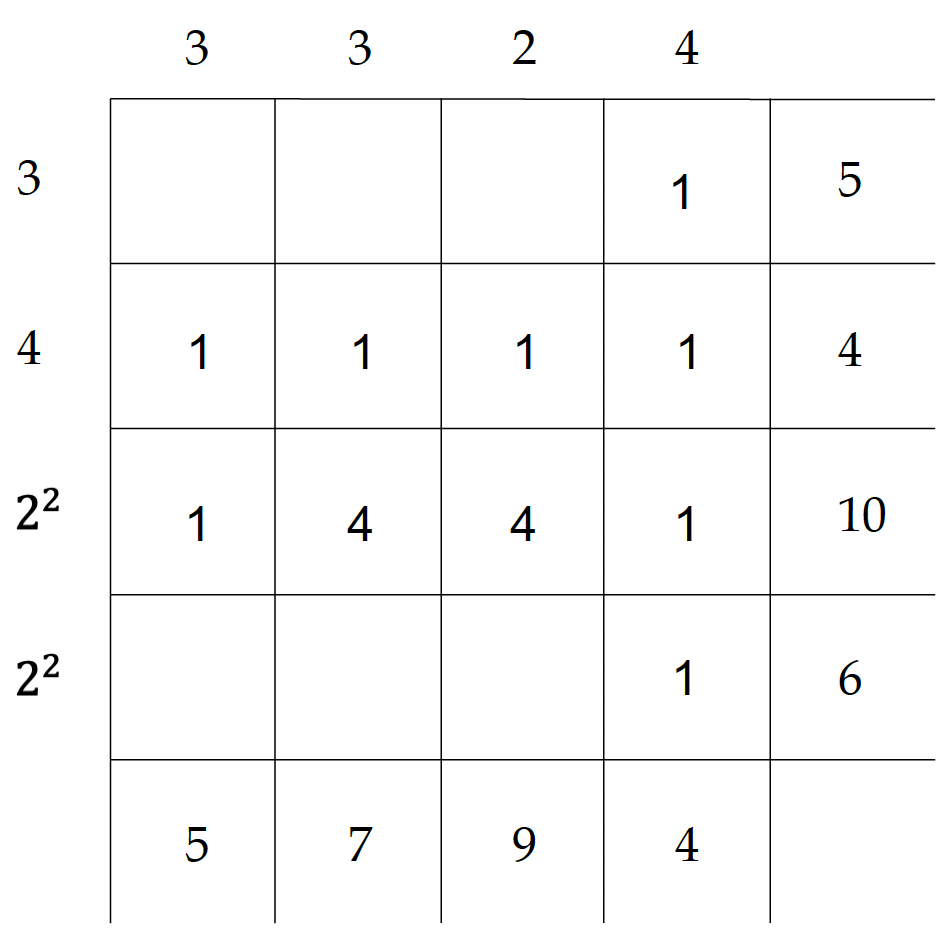
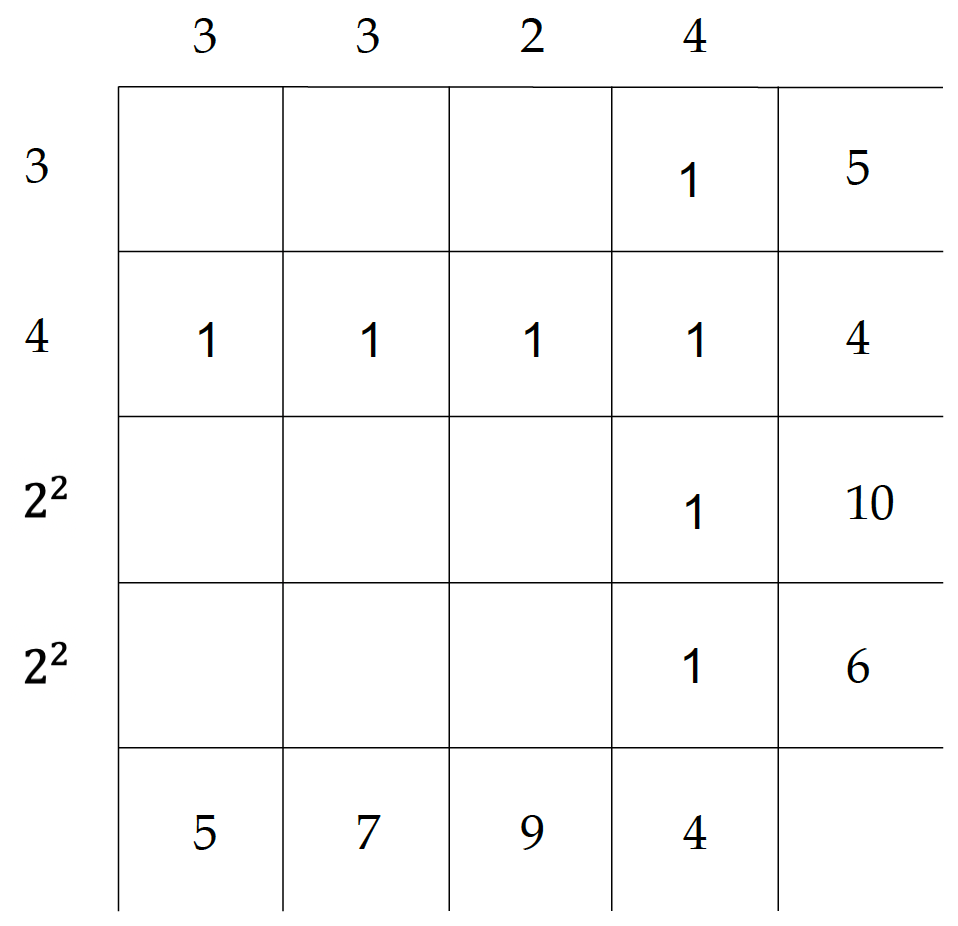
Frequencies that restrict more digits help reduce the grid’s possibilities. On this 4×4 grid, the sum of 4 with a frequency of 4 can only be satisfied by breaking 4 into four equal parts, 1111. We can see how these 1’s limit the possibilities of the other sums:
Let’s look at our current possibilities:
5/3: 1113 7/3: 1114, 1222 9/2 : 1134, 1224, 1233
10/2²: 1144, 2233 6/2²: 1122.
10 is restricted to 1144. The last column already contains a 1. That means two of the sums out of 5, 7, and 9 must hold a 4 while one of them holds the remaining 1. The sum 5 cannot hold a 4 and therefore holds the 1.
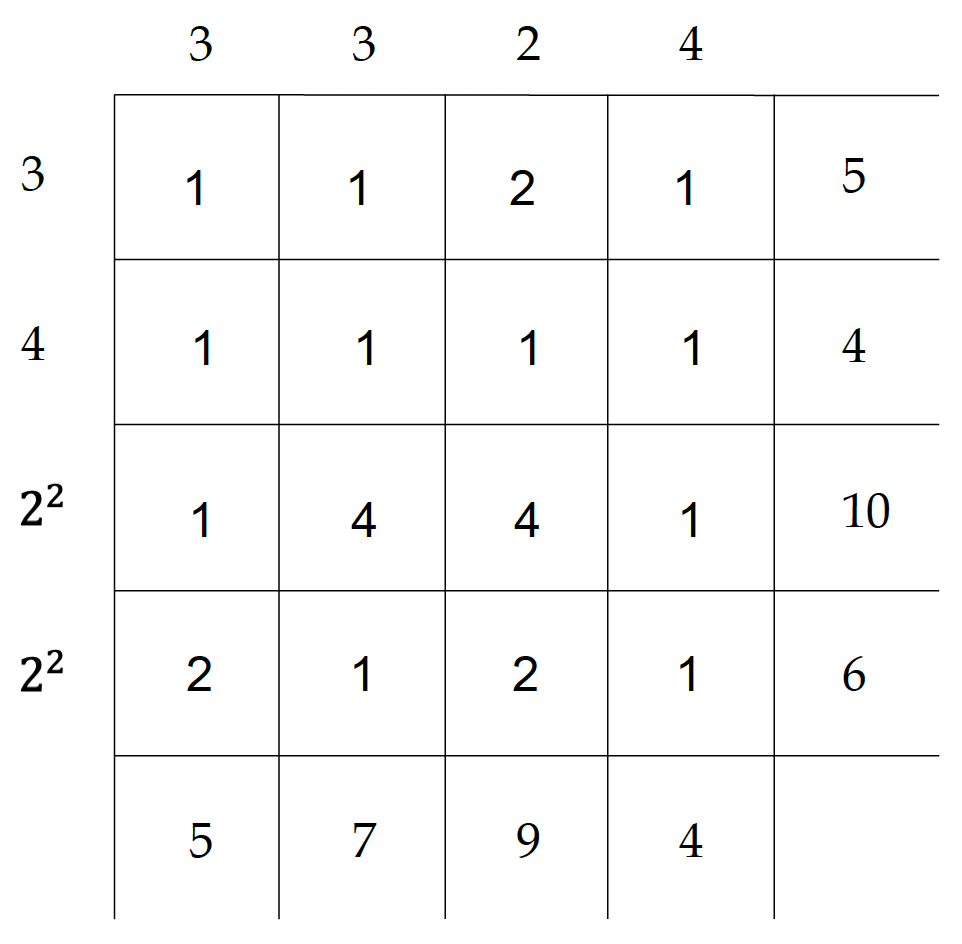
The remaining digits fall into place. In frequency puzzles, it is just as important to consider what is NOT possible as to consider what is.